Email marketing is entering a new phase in 2026.
For years, businesses used email automation mainly to send fixed sequences: a welcome email after signup, a discount after cart abandonment, or a follow-up message after a lead form. But this model is no longer enough.
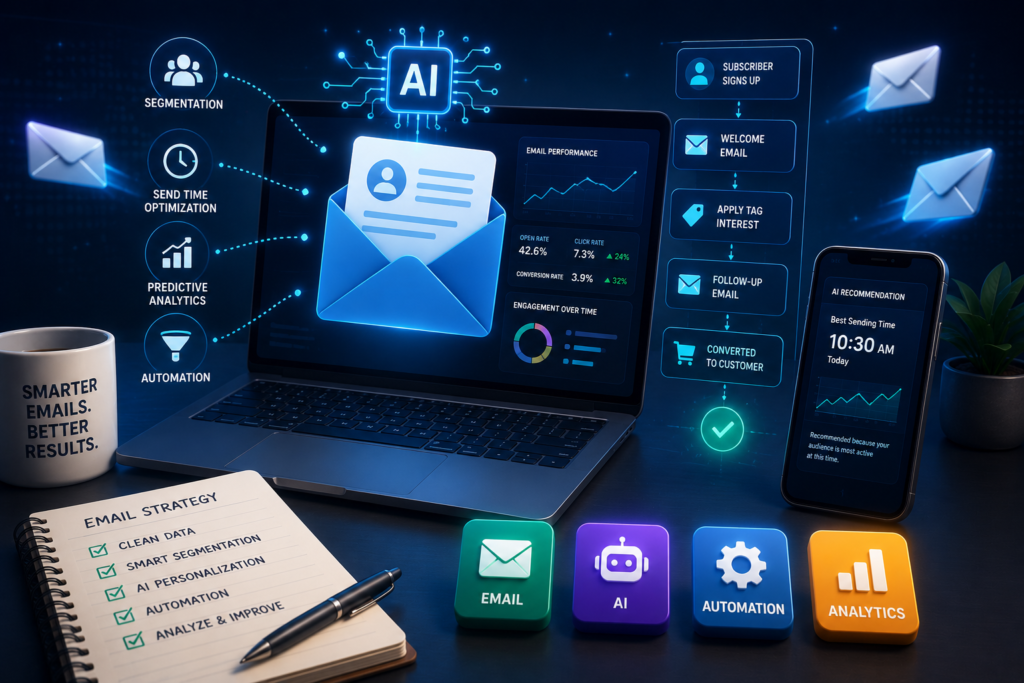
The new generation of AI email marketing tools is moving toward predictive automation, behavior-based personalization, and multi-channel customer journeys. Instead of only reacting to simple triggers, modern platforms are starting to analyze live engagement data, predict user intent, optimize send times, and adjust campaigns automatically.
For businesses, marketers, agencies, and online entrepreneurs, this shift is important. Email marketing is no longer just about sending messages. It is becoming a smarter system connected to data, AI, automation, CRM, SMS, WhatsApp, and customer behavior.
AI Is Changing the Way Email Campaigns Work
Traditional email automation is based on rules.
For example:
If a user signs up, send email A.
If they click a link, send email B.
If they do not open, send email C.
This still works, but it has limitations.
AI email marketing tools can go further. They can analyze patterns across thousands of subscribers and help marketers understand who is likely to buy, who needs more education, who is inactive, and when each person is most likely to engage.
This is why AI is becoming a major feature inside email platforms. The uploaded source material highlights a shift from basic rule-based campaigns to adaptive systems that use live data, predictive analytics, and customer journey orchestration.
This means email marketing is becoming more dynamic.
Instead of building one campaign for everyone, businesses can build smarter flows that adapt to different users.
Why This Matters for Digital Marketing
The inbox is becoming more competitive.
Customers receive many emails every day. At the same time, inbox platforms are getting smarter. Gmail, Apple Mail, and other email systems can filter, summarize, prioritize, or hide messages based on engagement signals and content quality.
That means generic emails are becoming weaker.
If an email looks automated, irrelevant, or low-value, it may be ignored quickly.
This creates a new challenge for marketers: email campaigns need to be more personalized, more useful, and better timed.
AI can help with this by improving:
send-time optimization,
audience segmentation,
subject line testing,
content personalization,
lead scoring,
deliverability monitoring,
and campaign performance analysis.
But AI alone is not enough. Businesses still need clean data, clear strategy, and human review.
The Rise of Predictive Email Automation
One of the biggest changes in email marketing is predictive automation.
Predictive automation uses data to estimate what a customer is likely to do next.
For example, AI can help identify:
which subscriber may buy soon,
which customer may become inactive,
which product someone may prefer,
which time is best to send an email,
which audience segment is more valuable,
and which campaign path should be used.
This is different from old automation because the system is not only following fixed rules. It is learning from behavior.
Platforms such as Klaviyo position themselves around AI-powered email, SMS, cross-channel profiles, predictive analytics, and omnichannel marketing for ecommerce brands. Klaviyo also highlights integrations with ecommerce platforms and real-time customer data to power personalized automation.
For ecommerce businesses, this can be powerful because purchase history, browsing behavior, cart activity, and product interest can all help create better email campaigns.
AI Agents Are Entering Marketing Platforms
Another important trend is the rise of AI agents inside marketing platforms.
HubSpot describes Breeze as its collection of AI tools and agents built into its customer platform to help marketing, sales, and service teams get more done.
This matters because AI is moving beyond simple content generation.
Instead of only asking AI to write an email, businesses can use AI to support larger workflows, such as:
building campaign ideas,
analyzing CRM data,
summarizing customer behavior,
supporting sales follow-up,
helping service teams,
and coordinating multi-channel communication.
This confirms a larger movement in marketing: AI is becoming part of the operating system of business communication.
Cold Email and Deliverability Are Also Becoming AI-Driven
AI is also changing cold outreach.
Platforms such as Instantly position themselves around automated outreach, lead databases, email deliverability tools, AI-powered CRM, automations, and AI agents.
This shows that email marketing is not only about newsletters and ecommerce campaigns.
B2B outreach is also becoming more automated.
However, this area requires caution.
Cold email campaigns can damage sender reputation if they are done with poor data, bad targeting, or aggressive sending volume. AI tools may help with personalization and deliverability, but businesses still need to respect email best practices and avoid spammy behavior.
For ANIMOX readers, the lesson is simple:
AI outreach is powerful only when it is built on clean data, relevant targeting, and responsible campaign logic.
Small Businesses Need Affordable AI Email Tools
Not every business can pay for enterprise marketing software.
That is why affordable AI email tools are becoming important.
Brevo, for example, presents itself as an email marketing platform for growing businesses with marketing and sales features that can scale as the company grows. Its comparison content highlights deliverability infrastructure, intuitive email features, and scalable solutions as key criteria for choosing an email platform.
This is important for small businesses because they need practical tools that are not too complex or too expensive.
A small business does not always need the most advanced system. It needs a tool that can help with:
email campaigns,
automation flows,
basic segmentation,
contact management,
SMS or WhatsApp if needed,
and performance tracking.
The best tool is not always the most expensive one. The best tool is the one that fits the business workflow.
AI Content Generation Is Now Part of Email Marketing
AI is also helping marketers create email content faster.
Campaign Monitor says its AI features can help scale email personalization and produce relevant, on-brand messages in minutes. The company also highlights that AI can adapt content to different segments, making personalization faster and more consistent.
This is useful because email teams often need many variations:
different subject lines,
different product angles,
different offers,
different audience segments,
different newsletter intros,
and different calls to action.
AI can speed up this work.
But businesses should not publish AI content without review.
A good email still needs brand voice, clarity, trust, and human judgment.
AI can draft faster. Humans still need to decide what is valuable.
Marketing Automation Is Becoming More Connected
Another key trend is that email marketing is becoming part of wider marketing automation.
Zapier’s 2026 marketing automation comparison lists tools for AI-safe workflow building, affordable all-in-one solutions, premium CRM-based systems, ecommerce automation, AI campaign building, analytics, and email automation. This shows that email is now part of a larger automation ecosystem, not a separate channel.
This matters because businesses rarely use only one tool.
A real marketing workflow may include:
website forms,
CRM,
email platform,
Google Sheets,
analytics,
AI content tools,
SMS,
WhatsApp,
ad platforms,
and reporting dashboards.
The businesses that win will be the ones that connect these tools into one clear system.
The Biggest Risk: Too Much Automation Without Strategy
AI email automation can help businesses move faster, but it can also create problems.
If a business automates without strategy, it may send too many messages, use weak personalization, damage deliverability, or create robotic communication.
Common risks include:
generic AI-generated emails,
poor segmentation,
unclean email lists,
high bounce rates,
bad timing,
irrelevant offers,
and over-automation.
This is why the most successful email marketing systems combine AI with human strategy.
AI should help marketers make better decisions, not replace the need for understanding the customer.
What Businesses Should Do Now
Businesses that want to benefit from AI email marketing should start with a simple plan.
First, clean the email list.
Bad data will damage automation. Invalid emails, duplicate contacts, fake leads, and inactive subscribers can reduce performance.
Second, segment the audience.
Not every subscriber should receive the same message. Group people by interest, behavior, product, source, or stage in the customer journey.
Third, use AI where it makes sense.
AI can help with subject lines, content ideas, send-time optimization, performance summaries, and campaign recommendations.
Fourth, track the results.
Important metrics include open rate, click-through rate, conversion rate, bounce rate, unsubscribe rate, spam complaints, and revenue per email.
Finally, improve the workflow continuously.
Email marketing is not a one-time task. It is a system that improves with testing, data, and iteration.
What This Means for ANIMOX Readers
For ANIMOX readers, this trend is important because it connects directly with digital marketing, email tools, data cleaning, AI automation, and business growth.
AI email marketing in 2026 is not only about writing better emails.
It is about building a smarter communication system.
A strong email system needs:
clean data,
verified contacts,
good segmentation,
AI-assisted personalization,
automation workflows,
performance tracking,
and useful content.
This is where tools become practical.
An email validator can protect list quality.
An open rate calculator can help understand campaign performance.
A subject line tester can improve engagement.
A spam words checker can reduce deliverability risk.
A workflow automation tool can connect everything together.
The real opportunity is not using one tool randomly.
The real opportunity is building a complete marketing workflow.
Final Thoughts
AI email marketing is becoming smarter, faster, and more predictive.
The old model of simple drip campaigns is being replaced by systems that analyze behavior, personalize content, optimize timing, and connect email with other marketing channels.
But the main rule remains the same:
Technology does not fix a weak strategy.
AI tools can improve campaigns, but businesses still need clean data, clear goals, useful content, and responsible automation.
The future of email marketing will belong to businesses that combine AI, automation, and human strategy into one connected system.
For marketers, agencies, ecommerce brands, and small businesses, 2026 is the year to stop treating email as a simple sending channel.
Email is becoming an intelligent growth engine.