On this page
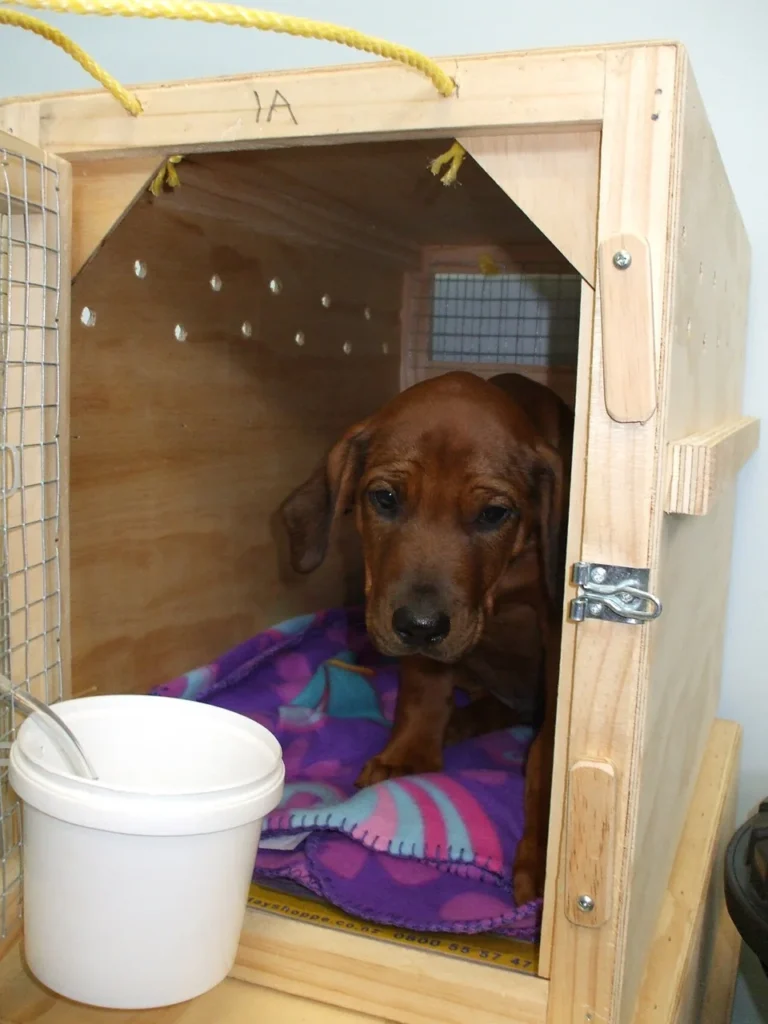
A dog crate can be a useful resting and management space when it is introduced patiently and fitted correctly. It should never be a substitute for daily movement, companionship or humane training. Dogs that panic when confined need an individualized approach, often involving veterinary or behavioral support. The size and type of crate should match the dog and intended use.
Dog crate types compared
| Crate type | Benefits | Watch-outs |
|---|---|---|
| Folding wire crate | Good airflow, easy visual monitoring | Check latches and protruding edges |
| Hard-sided plastic kennel | More enclosed and easy to wipe clean | Bulkier; measure ventilation and entry |
| Soft-sided travel crate | Lightweight and portable | Not suitable for powerful chewers or escape attempts |
| Furniture-style crate | Blends into living spaces | Ventilation, structural safety and cleaning vary |
| Heavy-duty crate | Extra construction strength | Not a substitute for assessing separation distress |
How big should a dog crate be?
Your dog should be able to stand without ducking, turn around and lie in a comfortable resting posture. Measure standing height and the body length from nose to the base of the tail; then verify the manufacturer’s usable internal dimensions instead of assuming the outer dimensions represent the living space. For growing puppies, a larger adult-size crate with a movable divider can be useful. If the dog already has reliable house-training, comfort—not artificially restricted floor space—should guide the setup.
Introduce the crate in calm stages
Begin with the door open. Toss treats inside or feed near the entrance, then allow voluntary exploration. Build time gradually while you remain nearby, keeping the dog relaxed. If the dog paws frantically, drools excessively, injures itself trying to escape or shows intense distress, stop and seek a humane behavior plan rather than forcing longer confinement. Never use the crate as punishment.
Crate setup checklist
| Area | Practical check |
|---|---|
| Location | Stable temperature, shade, no blocked airflow |
| Floor | Easy-to-clean surface and comfortable bed |
| Hardware | Secure door, no sharp edges or loose wires |
| Safety | Remove unsafe collars/accessories if appropriate for the dog’s setup |
| Routine | Regular breaks, water needs and appropriate activity |
| Travel | Use a restraint system appropriate to the vehicle and its safety standards |
Bedding and growing dogs
Choose bedding that suits your dog’s chewing behavior and medical needs. If your dog is older or large, a supportive crate mat can help, provided it does not reduce usable height or create a trip hazard. Explore our orthopedic dog beds for crates guide and our puppy house-training routine.
Decide what problem the crate is meant to solve
Write down the intended use before comparing products. An indoor resting area, a short management arrangement and a vehicle travel setup have different requirements. A crate used in a room needs a suitable location and an introduction plan. A crate for transport also needs to fit and be secured in the actual vehicle according to appropriate instructions. A model described as sturdy does not automatically meet every transport requirement.
Consider whether a crate is the right tool at all. A gated room or carefully arranged pen may be more suitable for some dogs and households. If the dog becomes distressed when confined, a stronger enclosure does not address the cause. Discuss the situation with a veterinarian or qualified behavioral professional rather than escalating to increasingly restrictive equipment.
Measure the route into the house as well as the dog
Large crates can be difficult to move through doors or around a stair landing once assembled. Measure the proposed location, the entry route and the space needed for the door to open. Think about whether a person can reach the latches without moving furniture. A crate placed in a cramped corner may fit on paper while being awkward to clean or use.
For a growing puppy, investigate whether the design has a suitable divider and how it is installed. Read the manufacturer’s instructions rather than improvising a partition from loose material. For an adult, compare usable interior dimensions with normal standing, turning and lying positions. External measurements may include handles, hinges or a thick shell that reduce the available room.
Assess construction by inspection, not by marketing labels
Look at latches, joins, edges and any removable tray. Check that doors open as intended and that no component is damaged before introducing the dog. The words heavy-duty and escape-resistant are not substitutes for inspecting the actual product. If a dog is attempting to force its way out, consider the welfare and injury risks instead of treating that behavior as a challenge for a stronger lock.
Soft-sided crates, plastic carriers and wire designs also differ in cleaning and ventilation. A lightweight folding model may be convenient for an already comfortable, supervised dog in some settings, while being unsuitable for a dog who chews or paws at fabric. Choose according to the individual dog’s needs and the manufacturer’s intended use, not just how compactly the empty product folds.
Create a household routine around the resting area
Decide who will guide children and visitors so the dog can rest without being disturbed. Avoid placing the crate beside the busiest doorway if constant movement prevents relaxation. Equally, a remote location is not automatically better if it separates the dog from a normal, reassuring household routine. Observe the individual dog’s comfort and adjust the arrangement rather than following a decorative room photograph.
Keep the area ventilated and away from heating equipment, strong direct sun and dangling hazards. Crate covers and bedding require product-specific judgment; they should not be added merely to copy an online setup. A dog who chews fabric or struggles with heat may need a different arrangement. Consult appropriate professional advice when a medical or behavioral issue changes what is suitable.
Progress by comfort rather than an internet timetable
Introduction should be gradual and positive, with steps suited to the dog. There is no reason to make the first trial coincide with a full day away from home. Arrange help with daily care before the dog arrives so confinement is not expected to solve a work-schedule gap. A training plan should include ordinary opportunities for activity, toileting and companionship.
If the dog is reluctant or distressed, reduce the difficulty and seek help where appropriate. Avoid assuming that every noise is a reason to ignore the dog, or that quietness always proves comfort. Observe the whole situation. Sudden changes in behavior, toileting or comfort deserve attention rather than being treated simply as a training failure.
Compare bedding as a separate purchase
Measure the usable floor area before ordering a mat. A thick bolster can take up interior room even when the product’s outer dimensions seem to match. Check whether the door can close properly with the chosen bedding in place and whether covers can be removed without dismantling the whole setup. A spare washable cover may be more useful than an elaborate layered arrangement.
Inspect bedding during ordinary cleaning. Damage, dampness or chewing may make an otherwise comfortable mat unsuitable. A crate floor should not become a place where wet textiles remain for long periods because they are inconvenient to remove. Refer to ANIMOX’s crate-bed guide for measurement and care considerations, without assuming that a particular filling solves every dog’s comfort needs.
Know when to stop and reconsider
Persistent escape attempts, visible injury, significant distress or a change in health warrant a different response from ordinary shopping comparisons. A crate should not become a place to leave an unresolved problem out of sight. Ask for suitable help and consider alternatives that protect both the dog and the household. Humane management depends on the care plan around the equipment, not on the price or thickness of its frame.
Keep the purchase decision reversible where possible: inspect the return terms, keep instructions and test the practical arrangement before relying on it. The useful outcome is a dog who can rest comfortably in an appropriate setting. Owning a particular style of crate is not a requirement for every successful home.
Frequently asked questions
Should a dog be able to stand in a crate?
Yes. The dog should also be able to turn and lie down in a comfortable posture.
Are crates good for puppies?
They can help establish a calm resting routine when introduced positively and used for suitable periods with appropriate breaks.
What if my dog panics in the crate?
Stop forcing confinement and consult a veterinarian or qualified behavior professional for an individualized plan.
Is a soft-sided crate safe for chewers?
It may not be appropriate for dogs that chew, scratch or try to escape because fabric panels can be damaged.
Continue reading on ANIMOX
Reference material and editorial verification
This informational guide does not replace individual veterinary or behavioral advice. No hands-on product testing is claimed.
What a dog crate should do
A dog crate should create a safe, comfortable resting space—not function as a punishment. Correct sizing matters: the dog should be able to stand, turn and lie down naturally. The ideal crate also depends on travel use, house-training stage and the dog’s chewing or escape habits.
Common crate mistakes
Owners often choose a crate that is too small, use it for too many hours or skip the introduction process. A crate is most useful when the dog associates it with calm routines, rest and safety.
Final takeaway
Choose the crate according to purpose, measurement and the dog’s comfort rather than simply buying the largest model on sale.
Photo: Chachacha369 / Wikimedia Commons, CC BY-SA 3.0. Resized and converted to WebP.