On this page
Are cooling mats safe for dogs? They can be a useful resting option when the particular mat is intact, suited to the dog, and used as instructed. They are not chew toys, medical devices, or a guarantee against heatstroke. The main risks are damaged filling, swallowed pieces, slipping, unsuitable placement, and treating a mat as protection from an unsafe environment.
Affiliate disclosure: ANIMOX may earn a commission if you buy through eligible merchant links, at no additional cost to you. Product links below lead to ANIMOX pages. We have not physically tested these products, and this article does not promise current stock, prices, or medical results.
The safest choice starts with your dog’s behavior. A dog that rests calmly on a pad has different needs from a puppy that mouths seams or an adult that shreds bedding. This guide explains what to check for each construction, how to introduce it, and when to stop using it.
Match the precautions to the type of cooling mat
Gel and pressure-activated pads
A sealed gel pad can be convenient, but punctures and torn seams expose its contents. Read the label for the specific formulation and do not transfer a safety statement from another brand. “Non-toxic” does not mean edible: a dog can also swallow the outer covering. Inspect both sides before use, and remove a pad that leaks, bulges unusually, or has loose pieces. A determined chewer is a poor candidate for an accessible gel-filled mat.
Water-filled cooling beds
Check the filling cap, valve, seams, and underside for moisture. Fill only as instructed and support the bed when moving it; a filled bed can be awkward to handle. Water on smooth flooring can make the area slippery. Do not add cleaners or additives unless the manufacturer specifically permits them. A water-filled model may not be freezer-safe. Keep sharp objects away from the pad and choose a flat surface where leaks will be noticed quickly.
Cooling-fabric mats and blankets
A fabric pad may avoid a refillable reservoir, but that does not establish chewing safety or continuous cooling. Check stitching, backing, detached threads, and any damaged waterproof layer. Follow the actual washing label. A cool-touch feel or Q-Max marketing number is not a guarantee of a safe body temperature. Once the surrounding room is hot, fabric alone cannot make it a safe place to leave a dog.
Chilled inserts and freezer-compatible pads
Only chill or freeze a model if its instructions allow that treatment. Do not put a rigid frozen insert directly against a dog’s skin or improvise with leaking ice packs. Follow the specified cover and handling directions, check the contact surface, and let the dog move away. Refrigeration instructions for one mat do not apply to another.
Elevated mesh beds
A raised bed is a different product category: it permits airflow beneath the resting area rather than offering a sealed cooling reservoir. Check frame stability, fabric tension, reachable gaps, and non-slip feet. A higher platform may be difficult for a dog with reduced mobility. Shade and a safe room temperature remain necessary.
A practical safety check before every use
- Read the exact model’s instructions, including size, location, cleaning, and storage.
- Inspect seams, valves, backing, and corners in good light.
- Choose a shaded, level area away from sharp objects and heavy foot traffic.
- Provide fresh water and a separate place to rest.
- Let your dog investigate voluntarily; do not trap it on the mat.
- Watch the first sessions for chewing, scratching, slipping, or avoidance.
- Recheck the surface and your dog during use. Remove the mat when damaged or when it is no longer a comfortable resting option.
Keep the package or a photograph of the product label. Knowing the brand, model, and filling is more useful in an accident than remembering that a mat was advertised as pet-safe. Trim snagging nails as part of normal care and inspect again after any digging behavior.
Are cooling mats safe for puppies and older dogs?
Puppies may explore unfamiliar bedding with their mouths. Supervise closely and remove the mat if the puppy bites its edges or works at a seam. Do not leave a puppy alone with a mat simply because the packaging mentions pets. Age recommendations and chewing resistance are product-specific.
For an older dog, check whether it can step onto and off the pad comfortably. A slippery covering or raised edge can be more important than the marketing description. Give a dog with limited mobility a stable resting alternative and ask its veterinarian about an appropriate setup if it cannot reposition itself. A cool pad does not replace supportive bedding or a treatment plan.
ASPCA warning about hydrogel ingestion
The ASPCA reports serious cases associated with ingestion of consumer hydrogel products, including some cooling pet pads. This does not establish that every mat or the catalog examples below contain the same formulation. Prevent chewing, remove damaged pads, and contact a veterinarian immediately after suspected ingestion. Do not rely on a non-toxic marketing label to rule out risk.
What to do if a mat tears or your dog swallows material
Remove the mat and prevent further access to leaked filling and scraps. Contact your veterinarian promptly if your dog has swallowed gel, fabric, foam, or plastic, even if a label says non-toxic. Tell the clinic the product name, approximate amount, time, and symptoms; keep the packaging available. Do not induce vomiting or give a home remedy unless a veterinary professional directs you to do so.
Stop use when a puncture reaches the filling. An improvised tape repair can become another chewable piece and may not restore the seal. Ask the manufacturer whether any repair is approved; replacement is preferable when safe repair cannot be established. Keep a damaged item away from children and other pets while arranging disposal.
Cleaning, storage, and overnight use
Remove surface dirt using the stated cleaning method. A washable cover does not mean the entire pad can go in a machine. Dry the item as instructed and check underneath for trapped moisture. Keep the storage area away from chewing pets; inspect the mat again when bringing it out after a season.
There is no universal safe number of hours. Overnight use depends on the model, the room, and whether the dog damages bedding or needs help moving. First establish calm, supervised use. Leave access to another resting surface and do not rely on the mat while the room heats up. If a dog cannot get away freely, change the arrangement.
Real catalog examples and the checks they need
These are construction examples, not products ANIMOX has tested or certified as safe. Verify the exact version before purchase.
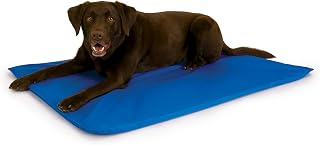
K&H Cool Bed III — Large, Chill Blue
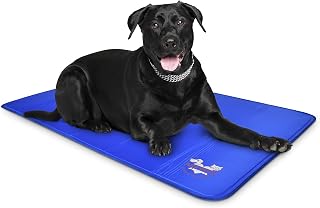
Large 44 × 32-inch K&H Cool Bed III illustrates a water-filled pad. Check its valve and underside. The manufacturer says not to freeze this model and provides filling and cleaning directions. Use those directions rather than instructions for a gel pad.
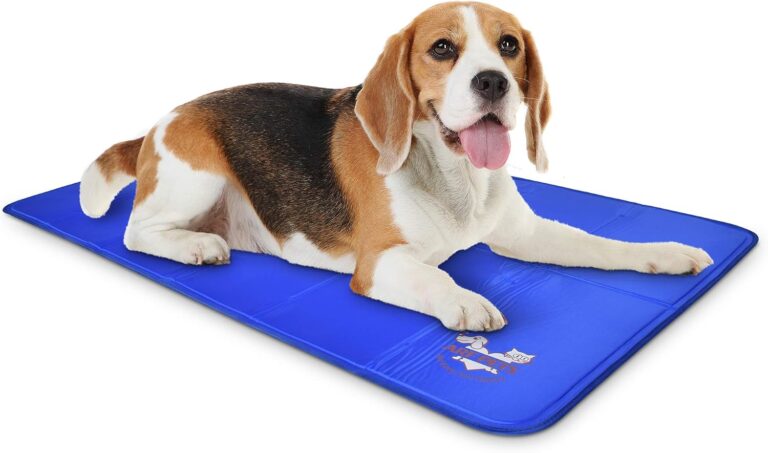
Arf Pets solid-gel pad
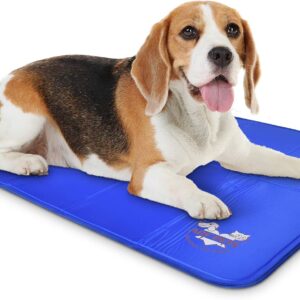
Arf Pets self-cooling gel pad illustrates sealed gel construction. Verify the size on the merchant page; our stored description does not establish it. Do not interpret the listing’s non-toxic wording as an ingestion guarantee.
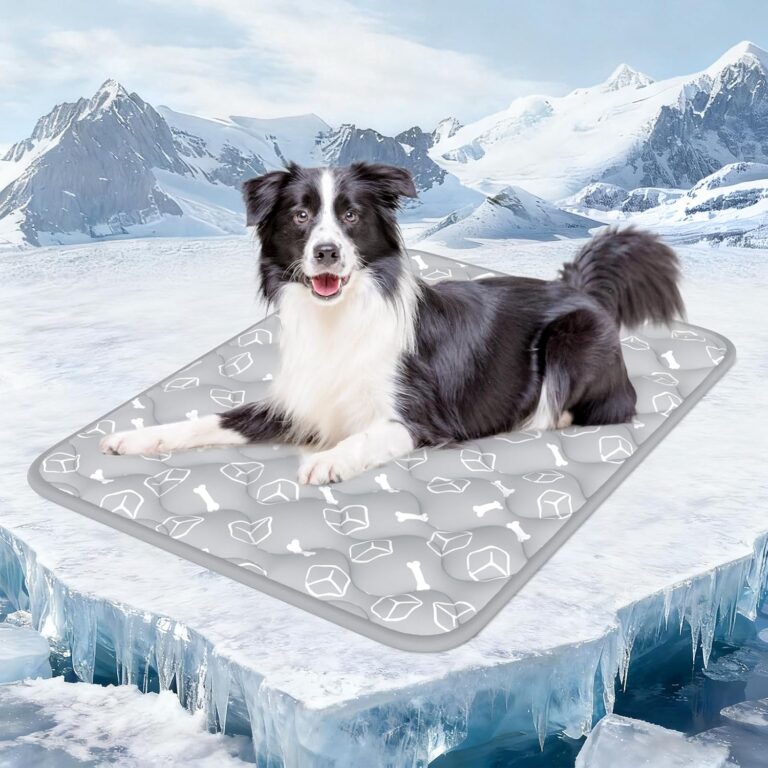
Rywell 2.0 — Elegant Grey, 44 × 32 inches
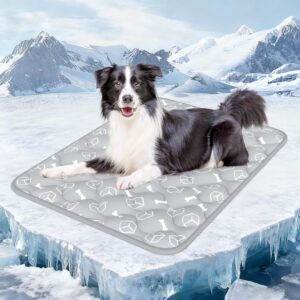
Rywell 2.0 Elegant Grey fabric mat is marketed with Arc-Chill fiber. Confirm the washing and backing instructions for this exact version. A fabric claim does not make it equivalent to a gel or water bed.
A cooling mat cannot make dangerous heat safe
Heavy or persistent panting, weakness, drooling, vomiting, confusion, or collapse can signal an emergency. Contact a veterinarian immediately and start cooling a suspected overheated dog with water while arranging urgent care. Do not wait to see whether a mat helps. The RSPCA heatstroke guidance explains warning signs and immediate action.
Keep rest areas shaded and cool, provide water, and avoid exertion in the heat. Do not leave a dog in a parked car with a mat. A warming pad, direct sun, or a poorly ventilated space can defeat the purpose of a cooling product. Comfortable contact with a surface is not evidence that the dog’s core temperature is safe.
Frequently asked questions
Are all cooling mat gels non-toxic?
No blanket statement is reliable. Read the specific label. Even a product described as non-toxic should not be swallowed, and the covering itself can pose a problem.
Can I put every cooling mat in the freezer?
No. Use only the chilling method allowed for that model. Some water-filled beds must not freeze, while other products have removable inserts with different directions.
Can a cooling mat be used in a crate?
Check the manufacturer’s permission and size. The dog should have a comfortable alternative and should not be confined to a surface that becomes warm, leaks, or is being chewed. A crate arrangement is unsuitable if the dog cannot avoid the mat.
Is a cooling mat safer than a cooling blanket?
Construction, condition, and your dog’s behavior matter more than the label. A sealed pad introduces puncture risks; a blanket may develop loose fabric or backing. Neither solves dangerous ambient heat.
Additional questions from the keyword research
Do vets recommend cooling mats?
Ask your veterinarian about the particular mat, chewing behavior and mobility needs. General advice about cooling does not endorse every model.
Can a cooling mat be used in a car?
A mat cannot make a parked car safe. Do not rely on it as temperature control.
Are electric pads equivalent to passive mats?
No. Electrical products have separate cable, moisture and operating precautions. Do not substitute an unverified human appliance.
Further reading
Explore the Dog Cooling Mats hub for relevant options and the dog bed guide for supportive resting alternatives. For model-specific precautions, consult K&H’s instructions; for broader warm-weather care, see AVMA guidance.
Editorial note: Informational guidance based on product descriptions and published veterinary and welfare resources; no hands-on testing or veterinary review is claimed.