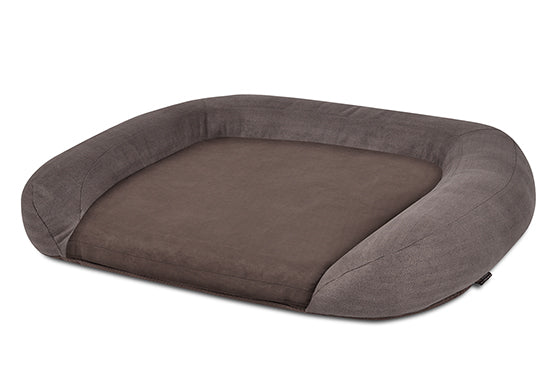
Illustrative resting scene; the catalog photos below identify specific products where included.
Disclosure: ANIMOX earns commissions from eligible purchases through product links on this site. This informational guide does not claim hands-on testing or veterinary review.
A soft cover and a supportive core are different parts of a bed. Plush fabric can sit over a stable insert, while a thick-looking cushion may compress deeply under a particular dog. The useful question is how the whole bed works during approach, rest, and getting up, rather than whether hard or soft sounds better.
Separate the cover from what is underneath
A plush top can feel soft to your hand while a firmer insert supports the dog beneath it. Conversely, a smooth surface can cover a cushion that collapses under load. Squeezing a corner does not tell you exactly how a dog’s whole weight will be supported.
Look for an actual core description, thickness excluding bolsters, and seller loading guidance. If density or firmness is missing, ask rather than inventing it from a photograph. Orthopedic and memory foam are not universal firmness ratings.
Observe three moments
First, watch the approach: does the bed slide or create a high step? Next, observe settling: does the dog keep repositioning, hang off the center, or avoid the raised sides? Finally, watch getting up: does the dog sink deeply or struggle with an edge?
Those observations help identify a setup problem, but do not diagnose pain or prove one material is medically better. New stiffness, discomfort, or a change in movement deserves veterinary attention rather than a series of guessed bedding purchases.
Sleeping position changes the space needed
A dog that curls into a corner may like a boundary. A sprawled sleeper may need an open center. Provide room for the dog’s larger relaxed positions instead of measuring only its smallest curled shape.
Bolsters add an edge but occupy area. A high-sided bed can feel cozy to one dog and become an obstacle to another. Match layout and access separately from the softness of the fabric.
What to consider for older or heavier dogs
Watch the dog settle and rise on the actual surface. Deep sinking, shifting fill, or a bed that slides during entry can make the arrangement awkward. Extra height is not an automatic improvement; it changes the step as well as the resting surface.
VCA’s osteoarthritis guidance includes supportive bedding as part of home care. It does not identify one firmness as right for every dog or establish a medical benefit for a particular catalog product.
If your dog chooses the floor
A dog on the floor may be choosing a cooler spot, more stretching room, or a location closer to people. Try a suitable bed in that preferred place before interpreting the choice as a request for firmer foam. Leave the dog free to use another comfortable resting area.
Offer a suitable alternative and observe it in the dog’s preferred resting area. Do not force use of a new bed or conclude that a rejected cushion is defective without considering the setup.
A practical shopping comparison
Compare core, sleeping area, entry, cleaning, and floor stability. Keep material claims separate from measurable specifications. The Dog Beds hub and published bed comparison provide live catalog starting points.
A washable cover can simplify care, but follow directions for its insert as well. A soft bed that remains damp or a firm one that slides can both be unsuitable despite their label.
Questions about firmness
Is a hard surface always bad for dogs?
Do not make a universal rule from occasional floor resting. Provide a comfortable option and discuss health-related concerns with the veterinarian.
Does more foam mean better support?
Not by itself. Thickness, construction, firmness, usable area, and the dog’s load are different factors.
How should I compare two beds without trying them?
Use the dog’s routine to narrow the layout: an open center for a sprawled sleeper, a manageable entry for difficult movement, and a stable base on your floor. Then obtain the missing core and care specifications. Firmness is one factor within that arrangement, not a stand-alone prescription.