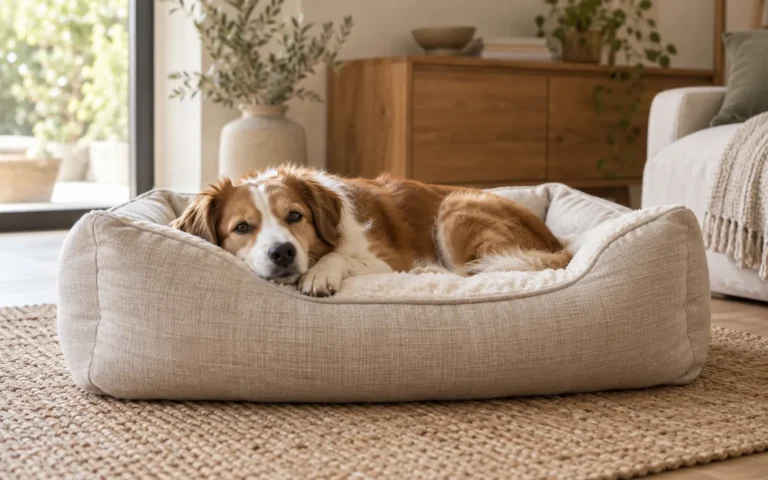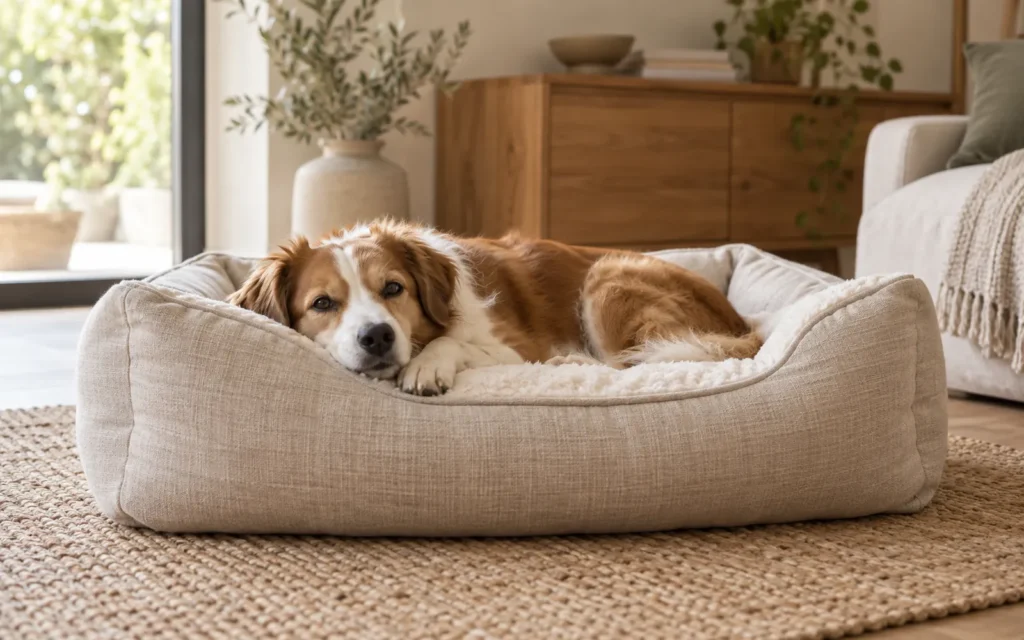
Illustrative resting scene; the catalog photos below identify specific products where included.
Disclosure: ANIMOX earns commissions from eligible purchases through product links on this site. This informational guide does not claim hands-on testing or veterinary review.
Start with a normal nap. Does your dog stretch across the floor, curl against a chair, or prop its head on an edge? That resting shape, the way it gets up, and your cleaning routine give you a better shopping brief than a popular size label. Measure those needs before choosing the design.
Start with the dog you have
Observe ordinary naps over a few days. Does the dog stretch onto its side, curl tightly, lean on an edge, or change positions frequently? Note the larger resting footprint, not just the smallest pose. A breed label cannot replace those observations.
Watch the route onto and off the bed. A raised edge that a young dog steps over easily may be awkward for a senior dog. New difficulty moving or apparent pain deserves a veterinary assessment; changing furniture alone is not a diagnosis or treatment.
Measure usable space, not the packaging
Record relaxed length and width, then compare them with the bed’s sleeping area. For a bolstered couch, ask for center dimensions excluding the sides. An exterior measurement can look generous while leaving a smaller usable center.
Mark the footprint on the floor where the bed will go. Leave a clear route for people and the dog. Make sure doors can open and that the bed will not be pushed into a cramped corner simply because it looked small in a photo.
Choose a layout for a reason
A flat mattress offers an open approach and no side bolsters taking space. A couch-style design provides boundaries but can narrow access. A soft nest or cave may appeal to a dog that likes enclosed resting, yet should not trap heat or make leaving difficult.
An elevated bed introduces frame stability and a step up. It is not automatically cooler or medically better. Compare the exact design, intended use, and your dog’s ability to get on and off it.
Read construction and care together
Look for a clear description of the core and cover. Ask what washable means: cover only, separate insert, or complete soft item. Waterproof may describe a liner rather than the whole bed. Those differences affect real maintenance.
A bulky cover needs room in the washer and a drying method you can follow. The insert may have completely different care instructions. For a chewer, reachable zippers, loose filling, and damaged seams deserve more attention than a decorative fabric choice.
Match location and routine
An indoor bed placed near the family serves a different purpose from one used for travel or inside a crate. Indoor washable wording does not establish outdoor suitability. A crate bed needs actual tray measurements and must leave appropriate movement and headroom.
Place a new bed in a familiar resting area and allow voluntary use. Familiar bedding can help only if it does not interfere with the product’s safe use. Keep another suitable resting choice available while the dog investigates.
A simple comparison worksheet
| Question | Your requirement | Exact model evidence |
|---|---|---|
| Usable sleeping area | Measured resting footprint | Center dimensions, not exterior alone |
| Access | Comfortable approach and exit | Entry height, shape and stability |
| Care | Routine you can maintain | Instructions for cover and core |
| Placement | Clear, appropriate location | Intended use and handling guidance |
Where to compare actual options
Use the dog bed shortlist for real catalog choices. For support-focused models, visit Orthopedic Dog Beds. For a cooling resting surface, Dog Cooling Mats addresses a different purpose.
Give each added feature a job. Bolsters offer an edge, a flat mat fits some trays, and a removable cover changes laundering. If a feature does not help the dog’s routine or your maintenance, it need not make the shortlist.
Two final checks
Should I buy the adult size for a puppy?
Consider the puppy’s current safety and behavior as well as future size. Extra space does not resolve chewing, supervision, or an unsuitable construction.
What if a dog ignores the new bed?
Move the bed to a familiar resting location and observe voluntary use. Temperature, doorway traffic, shape, and entry can explain rejection as much as the brand. Keep another comfortable option available while you adjust one part of the setup at a time.